
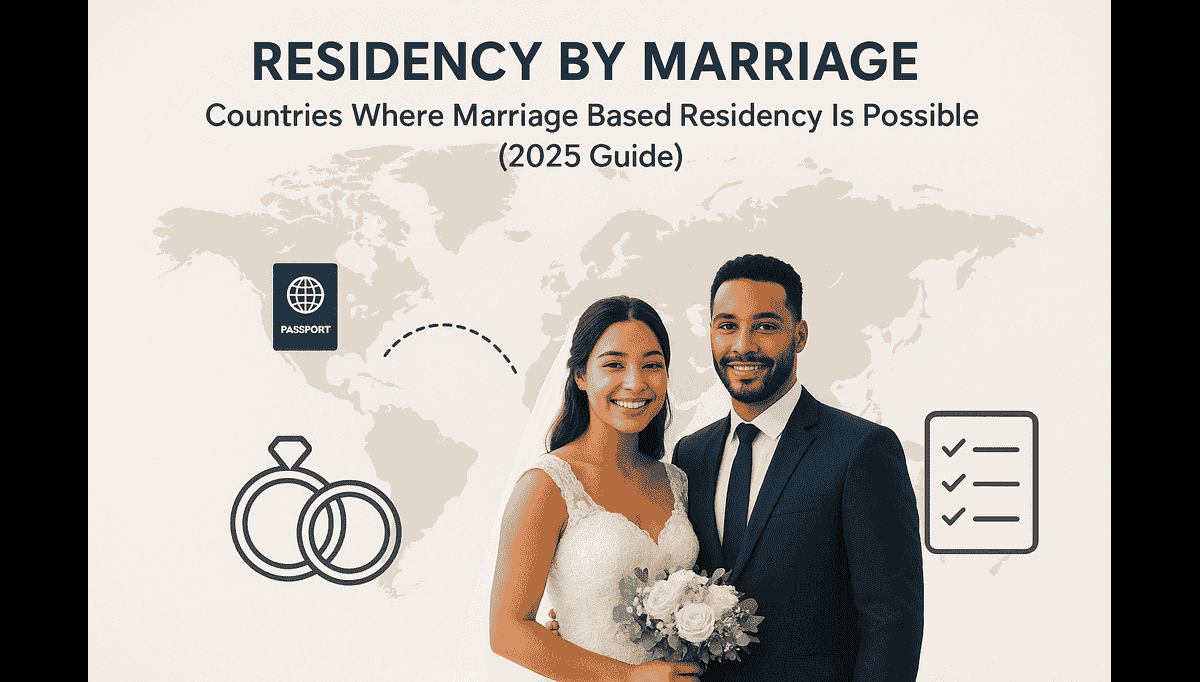
Residency by marriage is one of the most misunderstood pathways to obtaining permanent residency in different countries. Many people assume that residency through marriage works like a fast track to citizenship, but every country requires documents, background checks, and proof of a genuine relationship. Understanding how marriage-based residency works helps couples avoid legal issues and increases the chances of successful approval.
If you’re researching other related topics, you may also find helpful guides in Education, Travel, and Life Abroad on our site, such as our article on Visa-Free Countries for Nigerians.
What Residency by Marriage Actually Means
Many people believe that residency through marriage automatically grants citizenship to foreign spouses. In reality, residency by marriage only provides a foundation for temporary residence, not an instant passport. Governments use interviews, documents, and background checks to confirm genuine relationships before granting marriage-based residency. This protects immigration systems from fraud and ensures benefits are awarded to genuine couples.
Standard Requirements for Marriage-Based Residency
Countries have different procedures and requirements, but most residency by marriage applications require:
Proof of a real relationship
Photos together, call logs, chats, shared bills, and travel history help support marriage-based residency applications.
Identity verification
Applicants must provide passports, birth certificates, and marriage certificates to qualify for residency by marriage.
Background checks
Police clearance is required because marriage-based residency does not exempt individuals from security screening.
Financial stability
Governments check that the couple can support themselves before approving marriage-based residency.
For more documentation examples, you can check our guide on How to Legally Move Abroad.
European Countries That Allow Marriage Based Residency
Spain
Spain grants temporary residence after confirming residency by marriage. Couples must live together and renew their permits until they are eligible for long-term residency.
Germany
Germany allows spouses of citizens and permanent residents to apply for family reunification: language skills and income stability support marriage-based residency applications.
France
France offers residence cards to spouses once documents and evidence of the relationship have been approved. Maintaining shared living arrangements is crucial to residency-by-marriage policies.
Portugal
Portugal provides temporary residence through family reunification, and after continuous residence, applicants may qualify for permanent settlement or nationality.
Italy
Italy recognizes marriages registered locally or abroad. After verifying documents, the spouse can apply for residence and later progress toward citizenship.
For European travel options while waiting for documents, see our post on Cheapest Universities in Canada for Students.
Residency Duration Before Citizenship
Even after residency by marriage approval, citizenship takes years. Most European countries require:
-
continuous residence
-
proof of shared living
-
language proficiency
-
background checks
This ensures marriage-based residency supports long-term family life rather than short-term arrangements.
United States — Usually 3 years as a green-card holder (if married to a U.S. citizen)
How long: You can generally apply for naturalization after 3 years as a lawful permanent resident (green card) if you are married to and living in a marital union with a U.S. citizen for the whole 3-year period.
You may be able to file up to 90 days before the 3-year mark. USCIS+1
Key requirements after residency by marriage: be 18+, be a permanent resident for the required period, have continuous residence and sufficient physical presence in the U.S. (USCIS counts days), show you are living in marital union, demonstrate good moral character, pass English and civics tests (unless exempt), and submit evidence of spouse’s citizenship and validity of the marriage. USCIS+1
United Kingdom — Usually 3 years’ residence if married to a British citizen
How long: If you’re married to a British citizen, you generally must have lived in the UK for at least 3 years before applying for naturalisation as a spouse. GOV.UK
Key requirements after residency by marriage: hold indefinite leave to remain (or equivalent) or meet residence status rules, satisfy residence/absence limits, meet “good character” checks, pass Life in the UK Test, and meet English language requirements unless exempt. The Home Office has full guidance and application details. GOV.UK+1
Canada — No special shortcut: meet the standard physical presence requirement
How long: Marriage to a Canadian does not automatically change the timeline. To apply for Canadian citizenship, you must meet the general rules. For most applicants, that means being physically present in Canada for 1,095 days (3 years) out of the 5 years before applying.
(There is no separate “marriage fast-track” to citizenship.) IRCC+1
Key requirements after residency by marriage: legal permanent resident status, required physical presence days, income tax filing when required, language and knowledge tests (for ages that require them), and passing the citizenship application checks. Note also sponsorship rules if you were sponsored as a spouse (e.g., certain sponsorship conditions and bars). IRCC+1
Australia — Generally 4 years’ lawful residence, including 12 months as a permanent resident
How long: For citizenship by conferral, the general residence rule is 4 years of lawful residence in Australia immediately before applying, including the last 12 months as a permanent resident (with limits on absences).
Being married to an Australian helps secure partner visas and permanent residency, but the citizenship waiting period follows the standard residence rules. Immigration and citizenship Website+1
Key requirements after residency by marriage: permanent residency at decision time, residence/absence limits, good character, passing the citizenship test (unless exempt), and intent to live in or maintain ties to Australia. Partner visas are the route to PR; after PR, you must meet the general citizenship criteria. Immigration and citizenship Website+1
Germany — Simplified/shorter options for spouses, but not automatic citizenship
How long: Marriage to a German citizen can allow earlier naturalisation under simplified rules, but marriage alone doesn’t automatically confer citizenship.
Exact timing and conditions vary; local nationality authorities process applications and can apply simplified conditions to spouses. verwaltungsportal.hessen.de+1
Key requirements after residency by marriage: you must apply for naturalisation (it’s discretionary), generally demonstrate integration (language, financial stability), proof of marriage/cohabitation, and meet any local residence or other statutory conditions the authority sets. Always check the local Staatsangehörigkeitsbehörde for details. verwaltungsportal.hessen.de+1
France — Typically 4 years of marriage (with residence conditions)
How long: You can apply for French nationality by declaration after 4 years of marriage to a French national if certain conditions are met (this can extend to 5 years in some cases, depending on continuous residence or consular registration).
The rules are nuanced; for instance, time lived in France together and registration of the French spouse abroad affect the timeline. Service Public+1
Key requirements after residency by marriage: proof that the spouse was French at marriage and retained nationality, proof of continued marital life and integration (language requirement), absence of serious criminal record, and documentary proof of residency/civil status as required by Service-Public. Service Public+1
Spain — Fast route in-country: 1 year of legal residence (for spouses living in Spain)
How long: Spain offers a short route in some cases: a foreigner married to a Spanish citizen who has one year of legal residency in Spain can be eligible to apply for nationality by residence. (Spain’s general residency path is longer for others — e.g., 10 years — but marriage/residency in Spain can reduce that to 1 year). MJusticia+1
Key requirements after residency by marriage: legal residence in Spain for the required period (often 1 year for spouses living in Spain), proof of marriage and cohabitation, good civic conduct, and completion of the nationality application process with the Ministerio de Justicia/civil registry. Language and integration checks can apply. MJusticia+1
Italy — 2 years (if living in Italy) or 3 years (if living abroad), reduced by half with children
How long: The foreign spouse of an Italian citizen may apply after 2 years of marriage if resident in Italy, or 3 years if resident abroad; those terms are halved (i.e., 1 year / 1.5 years) if the couple has minor children born or adopted. (Times reset in some instances, e.g., if the Italian spouse was naturalised after marriage.) Consolato Italiano Londra+1
Key requirements after residency by marriage: documentation proving marriage and residency, language requirement (demonstrate adequate Italian level), absence of serious criminal record, and following the consular/Interior Ministry submission rules. Consolato Italiano Londra
Netherlands — Usually 5 years, but spouses can qualify earlier under specific rules (3 years together)
How long: Ordinary naturalisation typically requires 5 years of lawful residence. However, spouses/registered partners of Dutch nationals may qualify after 3 years of marriage/cohabitation under specific conditions (and in some cases may naturalise from abroad if the 3-year cohabitation condition is met). Check IND / Netherlands worldwide for details. IND+1
Key requirements after residency by marriage: continuous legal residence, proof you’ve been married and lived together for the required period, pass civic integration (in some cases), and satisfy other IND naturalisation conditions (identity, records, fees). Government.nl+1
Sweden — Usually 5 years, but spouses can sometimes apply after 3 years
How long: The main rule for adult applicants is 5 years of habitual residence, but if you are married to (or living with) a Swedish citizen, the requirement can be 3 years of residence in Sweden (and the couple normally must have lived together for 2 of those years). Authorities will consider language, integration, and continuity of cohabitation. Migrationsverket+1
Key requirements after residency by marriage: proof of habitual residence and cohabitation, meeting integration/language expectations (assessed by the Migration Agency), good conduct, and abiding by the Migration Agency’s evidence and absence rules. Processing times can vary. Migrationsverket+1
How to Prepare a Strong Application
A strong application for residency by marriage requires proper documentation and planning.
Gather relationship evidence
Photos, chats, trips, and joint leases strengthen marriage-based residency reviews.
Organize financial and housing documents.
Showing income stability improves the chances of approval for residency by marriage.
Attend interviews confidently
Immigration officers may ask about daily life, relationship history, and plans.
Conclusion
Residency by marriage is a legitimate pathway toward long-term stability when couples understand the requirements. With proper preparation, marriage-based residency becomes smoother and less stressful. Whether you’re planning a move to Europe or another region, staying informed will help you avoid delays and immigration complications.
FAQs
1. Does marriage automatically give me citizenship?
No. Residency by marriage only grants temporary or family-based residence. Citizenship often requires years of continuous residency.
2. Can I apply for residency immediately after marriage?
Yes, but you must submit documents proving the marriage is real before marriage based residency is approved.
3. Do all European countries offer residency by marriage?
Most do, but requirements differ. Always check each country’s official immigration website.
4. Can fake marriages lead to bans?
Yes. Immigration fraud leads to bans, fines, and long-term travel restrictions.
5. Is residency by marriage faster than work visas?
Sometimes, but it depends on the country, relationship proof, and document quality.




wow your article is simply a masterpiece, i like that, keep it up and will be checking for new update. do you post often? you can check the biggest webdesign freelancer in platform in germany called https://webdesignfreelancerdeutschland.de/ Thank you
wow i really enjoy reading this, do you post often ? i will check back for more update, you can also check me out at https://webdesignagentur.de.com/ one of the top Marketing Directory site in Germany